Interdisciplinary Studies in Ethics

Interdisciplinary Studies in Ethics

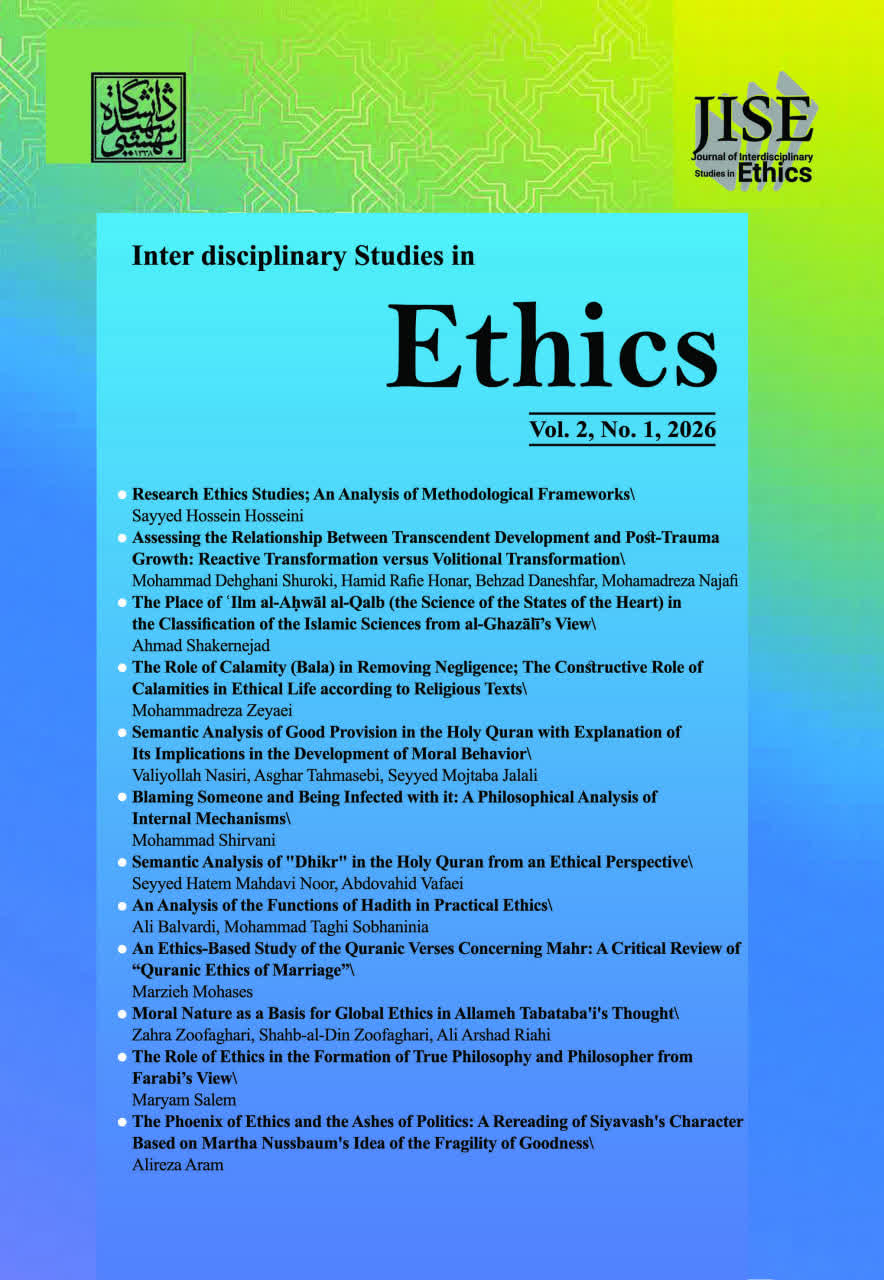
The Place of ʿIlm al-Aḥwāl al-Qalb (the Science of the States of the Heart) in the Classification of the Islamic Sciences from al-Ghazālī’s View

Document Type : Original Article

Author
Assistant Professor, Department of Religions and Mysticism, Faculty of Theology and Religious studies, Shahid Beheshti University, Tehran, Iran.
10.48308/jiethics.2026.243873.1060
Abstract
Introduction: Recent scholarship has established spiritual theology as an academic discipline concerned with the lived relationship between human beings and God and the process of spiritual transformation. Although Islamic Studies has produced extensive research on Sufism and ethics, the existence of a comparable discipline within the classical Islamic sciences has remained largely unexplored. Consequently, concepts such as ʿilm al-ākhirah (the Science of the Hereafter) and ʿIlm al-Aḥwāl al-Qalb (the Science of the States of the Heart) have often been interpreted as subsidiary themes rather than as elements of a distinct field of knowledge. This study investigates the place of ʿIlm
al-Aḥwāl al-Qalb in the classification of the Islamic sciences from al-Ghazālī's view and examines whether the contemporary framework of spiritual theology can serve as a heuristic model for recovering its disciplinary status.
Methodology: This study employs qualitative documentary research using thematic analysis with a theory-testing approach. Rather than comparing Islamic and Christian traditions, the conceptual framework of spiritual theology, particularly as developed
by Kees Waaijman and Sandra Schneiders, is used as an analytical lens to examine al-Ghazālī's major works, including Iḥyāʾ ʿUlūm al-Dīn, al-Munqidh min al-Ḍalāl, and Jawāhir al-Qurān. The identified characteristics of spiritual theology are tested against
al-Ghazālī's conceptual system to determine the place and function of ʿIlm al-Aḥwāl al-Qalb.
Findings: The findings show that al-Ghazālī organizes the Islamic sciences according to their role in spiritual transformation rather than merely by subject matter. Within this framework, ʿilm al-ākhirah occupies the highest rank and comprises ʿilm al-mukāshafah and ʿilm al-muʿāmalah. ʿIlm al-Aḥwāl al-Qalb belongs to the latter and constitutes a distinct discipline devoted to understanding, cultivating, and regulating the inner states of the heart. Its subject includes both spiritual virtues and vices and provides the foundation for the believer's ethical and spiritual formation. The analysis further indicates that
al-Ghazālī integrates earlier Sufi teachings into a coherent epistemological structure, thereby assigning the study of the heart a central position within beneficial religious knowledge.

Discussion: The study argues that ʿIlm al-Aḥwāl al-Qalb represents the closest functional equivalent in al-Ghazālī's intellectual system to what contemporary scholarship describes as spiritual theology, while remaining firmly rooted in the Quranic and Islamic intellectual tradition. This conclusion does not imply conceptual identity between the two traditions; rather, it demonstrates the usefulness of spiritual theology as a theoretical framework for rediscovering an overlooked discipline within classical Islam. By reconstructing the place of ʿIlm al-Aḥwāl al-Qalb in the classification of the sciences from al-Ghazālī's view, this study highlights the centrality of the heart in his understanding of religious knowledge and offers a new methodological perspective for the study of Islamic spirituality.
Keywords

Al-Sarrāj, Abu Nasr. (2001). Al-Lumaʿ fī al-Taṣawwuf [The Flashes in Sufism]. Kashan: Fayz Publications. [in Persian]
Al-Sarrāj, Abu Nasr. (2001). Al-Lumaʿ fī al-Taṣawwuf [The Flashes in Sufism] (Q. Khayyātīān, M. Khorsandī, A. A. Emāmī, & H. A. Emāmī, Trans.) [Translated from Arabic into Persian]. Kashan: Fayz Publications. [in Persian]
Baqli, R. (1972). Risālat al-Quds wa Risālat Ghalaṭāt al-Sālikīn [The Epistle of Holiness and the Errors of the Wayfarers] (J. Nurbakhsh, Ed.). Tehran: Yaldā Qalam. [in Persian]
Berger, P. L. (2014). The Heretical Imperative (F. Faridvālā, Trans., vol.1) [Translated into Persian]. Qom: University of Religions and Denominations. [in Persian]
Chan, S. (2009). Spiritual Theology: A Systematic Study of the Christian Life. IL: InterVarsity Press.
Fayḍ Kāshānī, M. M. (1993). Rāh-i Rowshan [The Illuminated Path] (vol.5). Mashhad: Astan Quds Razavi Publications. [in Persian]
Ghazālī, A. Ḥ. M. (1982). Al-Munqidh min al-Ḍalāl [Deliverance from Error] (M. M. Fouladvand, Trans.) [Translated into Persian]. Tehran: ʿAṭāʾī Publications. [in Persian]
Ghazālī, A. Ḥ. M. (1986). Jawāhir al-Qurān [The Jewels of the Quran] (H. Khadiv Jam, Trans., 3rd ed.) [Translated into Persian]. Tehran: Ettelāʿāt Institute. [in Persian]
Ghazālī, A. Ḥ. M. (2007). Iḥyāʾ ʿUlūm al-Dīn [The Revival of the Religious Sciences] (S. J. Mojtabavī, Trans.) [Translated into Persian]. Tehran: Scientific and Cultural Publications. [in Persian]
Ghazālī, A. Ḥ. M. (n.d.). Iḥyāʾ ʿUlūm al-Dīn [The Revival of the Religious Sciences] (A. R. ibn al-Ḥusayn
al-ʿIrāqī, Ed.). Beirut: Dār al-Kitāb al-ʿArabī. [in Arabic]
Ghazālī, M. M. (1991). Iḥyāʾ ʿUlūm al-Dīn [The Revival of the Religious Sciences] (Z. A. A. ibn al-Ḥusayn al-ʿIrāqī, Ed.). Beirut: Dār al-Hādī. [in Arabic]
Khwārazmī, M. M. (Trans.). (1996). Iḥyāʾ ʿUlūm al-Dīn [The Revival of the Religious Sciences] (H. Khadiv Jam, Ed.) [Translated into Persian from the work of Abū Ḥāmid Muḥammad al-Ghazālī]. Tehran: Scientific and Cultural Publications. [in Persian]
Malekian, M. (2019). Zamīn az Darīcheh-yi Āsmān [The Earth through the Window of Heaven]. Tehran: Soroush Molānā Institute. [in Persian]
Nouy, P. (1994). Quranic Interpretation and Mystical Language (I. Saʿādat, Trans.) [Translated into Persian]. Tehran: University Publishing Center. [in Persian]
Peters, G. (2011). On Spiritual Theology: A Primer. Journal of Spiritual Formation & Soul Care, 4(1): 1-12. https://doi.org/10.1177/193979091100400102
Shākernezhād, A. (2018). Modern Spirituality. Qom: Research Institute for Islamic Culture and Thought. [in Persian]
Shākernezhād, A. (2023). A Critical Rereading of Spiritual Theology in Christianity. Comparative Theology, 29, 87-101. [in Persian] https://doi.org/10.22108/coth.2023.135650.1772
Sheldrake, P. (2009). Spirituality and Theology. In New Christian Theology (vol.1) [Translated into Persian]. Qom: University of Religions and Denominations. [in Persian]
Ṭāhirī ʿIrāq, A. (1984). The Classification of the Islamic Sciences from Ghazālī's View. Maʿāref, 3, 81-90. [in Persian]‎ https://www.ensani.ir/fa/article
Waaijman, K. (2002). Spirituality: Forms, Foundations, Methods (vol.18). Leuven: Peeters Publishers.
Waaijman, K. (2007). Spirituality: A Multifaceted Phenomenon. Studies in Spirituality, 17, 1-113.               
https://doi.org/10.2143/SIS.17.0.2024643
Volume 2, Issue 1 - Serial Number 1
September 2026
Pages 53-74

  • Receive Date 06 April 2026
  • Revise Date 09 June 2026
  • Accept Date 30 June 2026
  • First Publish Date 30 June 2026
  • Publish Date 21 March 2026