Interdisciplinary Studies in Ethics

Interdisciplinary Studies in Ethics

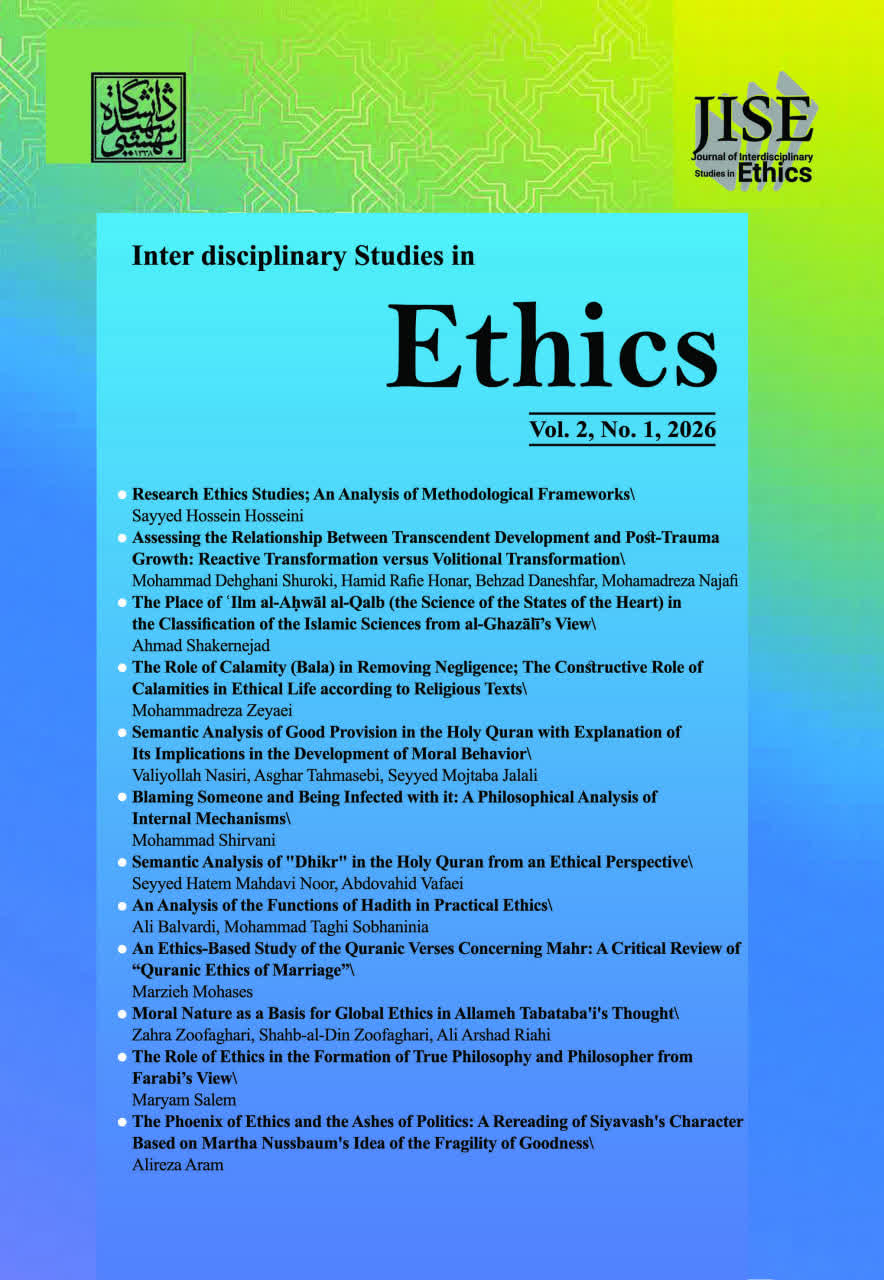
The Role of Ethics in the Formation of True Philosophy and Philosopher from Farabi’s View

Document Type : Original Article

Author
Associate professor of department of Philosophy and Theology, Faculty of Theology and Religious studies, Shahid Beheshti University, Tehran, Iran.
10.48308/jiethics.2026.241266.1022
Abstract
Introduction: Although, according to Aristotle, God is the possessor of true philosophy, the human being can still set out on the path of philosophizing and partake of true philosophy to the extent of his capacity. This is a philosophy that seeks truth for the sake of truth itself, not for profit, benefit, fleeting bodily pleasures, or the refutation of an opponent. Hence, in the Aristotelian and Platonic tradition to which Farabi belongs, not everyone under any condition can engage in this science; the observance of moral virtues and the reform of character are closely tied to philosophizing and attaining true philosophy. This article, by examining Farabi’s extant works, investigates the relation between happiness and philosophy, as well as the place and role of ethics prior to and accompanying philosophy and ethics grounded in philosophy in attaining true philosophy and forming the true philosopher.
Findings: According to al-Farabi, three virtues—theoretical, deliberative, and moral—together with practical crafts are necessary for the worldly and otherworldly happiness of human beings in societies.
Philosophy, both in its general and specific senses, is a virtue and the sole path to happiness, because its ultimate end is knowledge of God and assimilation to Him. Therefore, philosophy as a whole is knowledge and action, and thus noble character, and it is precisely that through which true human happiness is realized.
True philosophy renders its possessor worthy of leading society; hence, for Farabi, the true philosopher is the prophet, the imam, and the king, and the path of cultivating philosophy is the very path of cultivating kingship.
Discussion: Following the Platonists, he considers philosophy the sole path to happiness. He believes that the worldly and otherworldly happiness of members of societies depends on the acquisition of theoretical virtues, deliberative virtues, moral virtues, and practical crafts. In his view, the final end of all theoretical sciences is the same as that of first philosophy: not only knowledge of the First Principle, but assimilation to the Divine—an end that constitutes both the perfection of human creation and the perfection of human character, and that depends on acquiring all four virtues.

Τo attain true philosophy—which is the sole path to the ultimate perfection and happiness of human beings—one must properly direct all one’s animal and human faculties: employ the appetitive and irascible faculties toward the attainment of true virtues, and guide the rational soul so that it does not fall into sophistry and falsehoods. With the help of ethics, one reforms one’s speech and conduct; through geometry, one prepares the mind fully to receive universal intellects and to analyze and understand philosophical matters; and through logic, one safeguards the mind from error and distinguishes truth from falsehood. Farabi explicitly states that anyone who wishes to understand Plato’s and Aristotle’s intent in composing philosophical works must first fully master logic and ethical discipline, and then proceed to natural science and metaphysics. In this way, one realizes that their sole aim was to identify the beings of the world as they truly are, to the extent of their capacity—not to invent, discover, utter strange novelties, display rhetoric, or merely encourage others toward this science.
Some have argued that the ethics required, from Farabi’s view, for the study of philosophy is a pre-philosophical ethics distinct from philosophical ethics grounded in theoretical philosophy. They regard pre-philosophical ethics as consisting of virtues that are commonly deemed noble and thus based on religious and customary virtues, and therefore non-philosophical and non-demonstrative. However, the religious, customary, and commonly accepted nature of pre-philosophical ethics does not render it non-demonstrative or non-philosophical, because, for Farabi, the origin of commonly accepted opinions (mashhūrāt) is philosophy. Since, according to Farabi, religion consists of determinate and limited opinions and actions prescribed by the first ruler of the city for a group of people, religion can be considered the source of these commonly accepted views. Yet, from Farabi’s perspective, the theoretical and practical doctrines of religion are derived from philosophy; therefore, the origin of commonly accepted opinions can ultimately be said to be philosophy. If philosophy is certain, these commonly accepted opinions will also be certain and correspond to reality; if it is conjectural, they too will be conjectural and not correspond to reality. Hence, pre-philosophical ethics is also grounded in philosophy and can be demonstrative or non-demonstrative (probabilistic), even though its acceptance as commonly accepted judgments is not accompanied by argument or demonstration and is made acceptable merely by their widespread acceptance. Such ethics is necessary both prior to learning philosophy and throughout it.
The relationship between pre-philosophical ethics and philosophical ethics may be likened to the relationship between pre-philosophical geometry and geometry as one of the mathematical sciences. Just as pre-philosophical geometry serves only to prepare and cultivate the mind of the learner for grasping deep philosophical concepts and discovering first causes, remaining general and elementary and not entering into the detailed study of geometry grounded in logic and arithmetic—so that one at this stage is not yet called a geometer—so it is with ethics. Pre-philosophical ethics is a general and universal ethics that merely places the human soul on the proper path toward acquiring true virtues, without engaging in the detailed issues discussed in the science of ethics, which is a branch
of practical philosophy and posterior to theoretical philosophy. At the stage of pre-philosophical ethics, a person is not called a moral philosopher; rather, he is simply a refined individual who strives, by observing moral standards, to make only the discovery of truth his guiding principle and ultimate aim. Therefore, both pre-philosophical geometry and pre-philosophical ethics are grounded in philosophy; yet, when they function as preliminaries and the starting point of philosophizing, they are employed—independently of their philosophical principles—to render the individual intellectually and morally disposed for attaining true philosophy.
Keywords

Ammonius (1991), On Aristotle Categories, S. Marc Cohen and Garreth B. Matthews (transl.), Richard Sorabji (Intro.), Ithaca, New York: Cornell University Press.
Aristotle (1995), The Complete Works of Aristotle, V.1&2, Janatan Barnes (ed.), USA & UK: Prinston University Press.
Druart, Thérèse-Anne (2016), “Logic and Language” in The Routledge Companion to Islamic Philosophy, Richard C. Taylor & Luis Xavier López-Farjeat (ed.), Londen and New York: Routledge, Taylor & Francis Group.
Druart, Thérèse-Anne (2020), “Al-Fārābī”, in Stanford Encyclopedia of Philosophy, first published: Jul 15, 2016, substantive revision: Jul 24, 2020. https://plato.stanford.edu/entries/al-farabi.
Druart, Thérèse-Anne (2021), “Alfarabi’s Directing Attention to the Way of Happiness or the Way out of the Cave” in The Pursuit of Happiness in Medieval Jewish and Islamic Thought: Studies Dedicated
to Steven Harvey,
FHG ed. by Yehuda Halper, PATMA 1 (Turnhout: Brepols, 2021), pp. 91-103.
https://doi.org/10.1484/M.PATMA-EB.5.122266
Epictetus (1866), The Works of Epictetus, Consisting of his Discourses in Four Books, The Enchiridion, and Fragments, Elizabeth Carter (ed.), Thomas Wentworth Higginson (transl.), Boston: Little Brown and Company.
Epictetus (2021), How to Be Free: An Ancient Guide to the Stoic Life, trans. Nastaran Saremi, Tehran: Charkh. [In Persian]
Farabi, Muhammad b. Muhammad (1910), Ma Yanbaghī an Yuqaddam Qabl Ta‘allum Falsafat Aristuṭālīs, in Majmū‘at Mabādi’ al-Falsafa al-Qadīma, Cairo: al-Maktaba al-Salafiyya. [in Arabic]
Farabi, Muhammad b. Muhammad (1930), Sharḥ Risālat Zīnūn al-Kabīr al-Yūnānī, Hyderabad Deccan: Majlis Dā’irat al-Ma‘ārif al-‘Uthmāniyya. [in Arabic]
Farabi, Muhammad b. Muhammad (1930), Tajrīd al-Risāla al-Da‘āwī al-Qalbiyya, Hyderabad Deccan: Maṭba‘at Majlis Dā’irat al-Ma‘ārif al-‘Uthmāniyya. [in Arabic]
Farabi, Muhammad b. Muhammad (1961), Falsafat Aristuṭālīs wa Ajzā’ Falsafatihi wa Marātib Ajzā’ihā wa al-Mawḍi‘ alladhī minhu Ibtidā’ wa Ilayhi Intahā, ed. Muhsin Mahdi, Beirut: Lajnat Iḥyā’ al-Turāth al-Falsafī al-‘Arabī. [in Arabic]
Farabi, Muhammad b. Muhammad (1974), “The Philosophy of Plato, Its Parts and the Order of Its Parts from Beginning to End”, in Plato in Islam, ed. and annotated by ‘Abd al-Raḥmān Badawī, under the supervision of Mahdi Mohaqqeq and Toshihiko Izutsu, Tehran: Institute of Islamic Studies, McGill University (Canada) in cooperation with the University of Tehran.
Farabi, Muhammad b. Muhammad (1985), al-Jam‘ bayna Ra’yay al-Ḥakīmayn, ed. Albert Nasri Nader, Tehran: Maktabat al-Zahrā’. [in Arabic]
Farabi, Muhammad b. Muhammad (1985), Fuṣūl Muntaza‘a, ed. and introduction by Fawzī Metrī Najjār, Tehran: Maktabat al-Zahrā’. [in Arabic]
Farabi, Muhammad b. Muhammad (1987), Risālat al-Tanbīh ‘alā Sabīl al-Sa‘āda, ed. Suḥbān Khalīfāt, Jordan: University of Jordan. [in Arabic]
Farabi, Muhammad b. Muhammad (1988), al-Manṭiqiyyāt li’l-Fārābī, vol.1, ed. Muhammad Taqi Dāneshpazhuh and Mahmoud Mar‘ashi, Qom: Ayatollah Mar‘ashi Najafi Public Library. [in Arabic]
Farabi, Muhammad b. Muhammad (1990), Kitāb al-Ḥurūf, ed. Muhsin Mahdi, Beirut: Dār al-Mashriq. [in Arabic]
Farabi, Muhammad b. Muhammad (1991), Kitāb al-Milla wa Nuṣūṣ Ukhrā, ed. Muhsin Mahdi, Beirut: Dār al-Mashriq. [in Arabic]
Farabi, Muhammad b. Muhammad (1995a), Taḥṣīl al-Sa‘āda, ed. ‘Alī Bū Mulḥim, Beirut: Dār wa Maktabat al-Hilāl. [in Arabic]
Farabi, Muhammad b. Muhammad (1995b), Ārā’ Ahl al-Madīna al-Fāḍila, with commentary by ‘Alī Bū Mulḥim, Beirut: Dār wa Maktabat al-Hilāl. [in Arabic]
Farabi, Muhammad b. Muhammad (1996a), Kitāb al-Siyāsa al-Madaniyya, commentary by ‘Alī Bū Mulḥim, Beirut: Dār wa Maktabat al-Hilāl. [in Arabic]
Farabi, Muhammad b. Muhammad (1996b), Iḥṣā’ al-‘Ulūm, ed. and commentary by ‘Alī Bū Mulḥim, Beirut: Dār wa Maktabat al-Hilāl. [in Arabic]
Hadot, P. (1999), Philosophy as a Way of Life: Spiritual Exercises from Socrates to Foucault, Arnold I. Davidson (ed.), Michael Chase (transl.), UK & USA: Blackwell Publishers Ltd.
Mattila, J. (2017), “The Ethical Progressions of the Philosophers” in al-Razi and al-Farabi, in Arabic Sciences and Philosophy, vol.27, pp. 115-137. https://doi.org/10.1017/S0957423916000114
Mattila, J. (2022), “The Eudaemonist Ethics of al-Fārābī and Avicenna”, in Islamic Philosophy, Theology and Science, Texts and Studies vol.116, ed. by Hans Daiber, Anna Akasoy, Emilie Savage-Smith, Boston: Brill.
Porphyry (1987), “The Life of Plotinus”, in The Collected Works of Plotinus, vol.2, trans. Mohammad Hasan Lotfi, Tehran: Kharazmi. [In Persian]
Salem, M. (1996), “The Prerequisites for Learning Aristotle’s Philosophy from the Perspective of Ammonius and Farabi”, Hikmat-e Sina’i, no.57 (Spring-Summer), pp. 125-146. [In Persian]
Sorabji, R. (1990), “The Ancient Commentators on Aristotle”, in Aristotle Transformed: The Ancient Commentators and their Influence, Richard Sorabji (ed.), cap. 1, pp. 1-30, Ithaca, New York: Cornell University Press.
Sorabji, R. (1991), The Introduction to Ammonius, On Aristotle Categories, S. Marc Cohen and Garreth B. Matthews (transl.), Richard Sorabji (Intro.), Ithaca, New York: Cornell University Press.
Zargar, N. (2019), “An Examination of the Nature of Language in Farabi’s Philosophy of Language”, Philosophy, 47(1), pp. 121-140. [In Persian] https://doi.org/10.22059/jop.2019.74469
Volume 2, Issue 1 - Serial Number 1
September 2026
Pages 237-260

  • Receive Date 26 August 2025
  • Revise Date 20 November 2025
  • Accept Date 08 February 2026
  • First Publish Date 08 February 2026
  • Publish Date 21 March 2026