Interdisciplinary Studies in Ethics

Interdisciplinary Studies in Ethics

Journal Title:  Interdisciplinary Studies in Ethics
Country of Publication: Iran, Tehran.
Publisher: Shahid Beheshti University
Format: Online
Online ISSN:  3115-7173
Frequency: Semiannual
Publishing Schedule: June, and December
Language:  Persian, including English abstracts and bibliographies.
Open Access: Yes, free access to articles.
Article types: Research and review papers.
Primary Review: 10 days, approximately.
Peer Review Policy: Double-blind peer-review.
Average refereeing time: 24 weeks
Acceptance percentage: 20%

The cost of publishing an article:  6 milion Rials
Citation Style: The APA citation style

COPE: The Journal of Interdisciplinary Studies in Ethics follows the policies and guidelines of the Committee on Publication Ethics (COPE) and abides by its Code of Conduct in dealing with potential cases of misconduct. 
Copyright: Authors retain unrestricted copyrights and publishing rights.
Type of License: Creative Commons — Attribution 4.0 International (CC BY-NC 4.0).
Required files to upload: Authors must submit the following essential files through the manuscript submission system: 1. Main Manuscript File (without the author details and prepared based on the provided template. 2. Title Page, 3. Authorship Form (must include the article title, full names of all authors, and be signed by all authors), 4. Conflicts of Interest Form (must be signed by the Corresponding Author and uploaded with the Main Manuscript File).
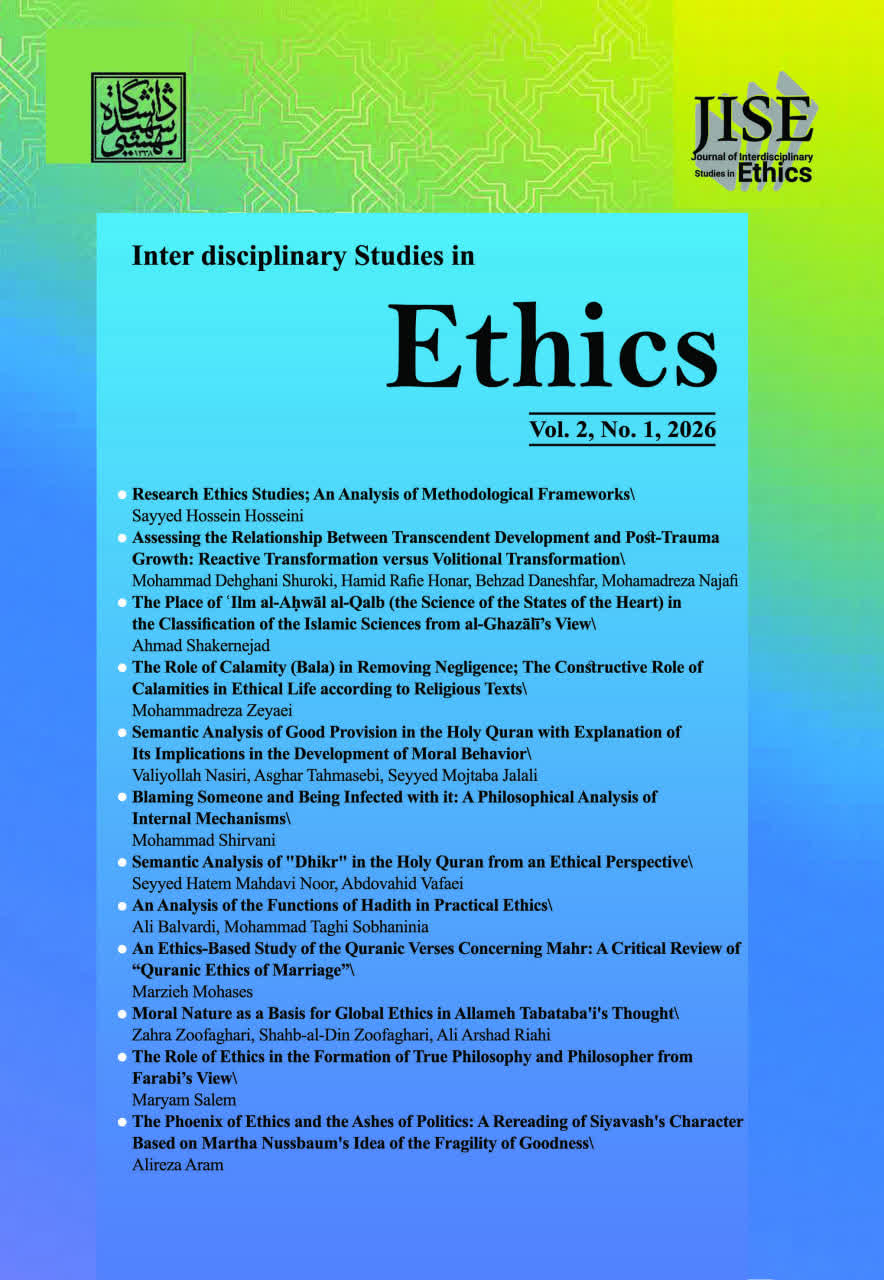
Current Issue: Volume 2, Issue 1, September 2026, Pages 7-278 

Publication Information

Publisher
Shahid Beheshti University

Director-in-Charge
Editor-in-Chief
International Editorial Board
Editorial Board
Manager
Executive Director

Frequency
Semiannual
Print ISSN
Online ISSN

Indexing and Abstracting

Keywords Cloud

  • Ethics
  • Accountability
  • Virtue Ethics
  • virtue
  • ethical principles
  • Islamic Ethics
  • Higher education
  • Persian
  • Sustainable development
  • AI ethics
  • Free will
  • Farabi
  • reason
  • character
  • Shahnameh
  • tragedy
  • images
  • Practical Reason
  • Quran
  • Kant
  • concept
  • Holy Quran
  • Semantics
  • Validation
  • care
  • students
  • Farhangian University
  • moral values
  • happiness
  • Revelation
  • Thematic Analysis
  • Forgiveness
  • Disagreement
  • Agricultural development
  • research methodology
  • Ayatollah Sobhani
  • Literacy
  • ethical values
  • environmental conservation
  • Moral Responsibility
  • solutions
  • Nussbaum
  • States
  • pandemic diseases
  • analysis
  • Textbooks
  • semantic network
  • moral behavior
  • Molana
  • AI
  • Interpreter mechanism
  • Split brain
  • indulgence
  • Izutsu
  • lexical semantics
  • moral psychology
  • Morality-as-Cooperation Theory
  • MAC-Q
  • Environmental Ethics
  • Agricultural Ethics
  • Land Reclamation
  • Tooba Plan
  • history of hadith
  • Kufa School
  • Qom School
  • writing on asceticism
  • History of Universities
  • Europe and the United States
  • University Structure
  • public good
  • Genetic engineering
  • Genetic enhancement
  • virtue theory
  • false brothers
  • philosophy of technology
  • misunderstanding
  • moral teachings
  • Abortion
  • Doctrine of Double Effect
  • Philippa Foot
  • Natural Goodness
  • Negative and Positive Duties
  • The ugliness of punishment without clarification
  • Monotheistic Ethics
  • Moral Epistemology
  • Moral Acquitta
  • Moral Transgressio
  • Mullā Ṣadrā
  • moral literacy
  • Information Technology Ethics
  • Applied Ethics
  • Ethics Research in Iran
  • Research Pathology
  • Evidence-Based Policymaking
  • normative evidence
  • Ethics and Policymaking
  • Moral Decision-Making
  • vices
  • virtues
  • necessity of causal correspondence
  • The Responsibility Gap Challenge
  • Optimistic Approach
  • Pessimistic Approach
  • Environmental legal regulations
  • Teaching of Islam
  • causes of the decline of moral values
  • Taqwā
  • Iḥsān
  • The Semantic Organ
  • A priori structure
  • unified soul
  • single-domain (monistic)
  • social ethics
  • true philosophy
  • true philosopher
  • Ethical Guidance Methodology
  • Divine Lutf
  • Prophecy and Imamate
  • Virtue Ethics and Exemplarism
  • Ismah
  • The “Lexical Semantic Analysis” Method
  • The Semantic Qualitiy
  • Calamities
  • negligence
  • purpose of creation
  • blessings
  • human awakening
  • Blame
  • English Environmental ethics
  • Judaism
  • amanah
  • bal tashchit
  • Shekhinah
  • tikkun olam
  • Shi‘ism
  • Imami ethical writing
  • Kufan ethical school
  • Fathites
  • Waqifites
  • bibliographical sources
  • Global Ethics
  • Critical methodology
  • research ethics
  • philosophy of science
  • Epistemology of ethics
  • semantic system of the Quran
  • discipleship
  • master
  • disciple
  • reactive transformation
  • Islamic psychology
  • The Fragility of Goodness
  • Unit of Analysis of the Issue
  • Transcendent Development
  • Posttraumatic Growth
  • Voluntary Transformation
  • Ijtihad Method
  • spiritual theology
  • spiritual studies
  • the science of the states of the heart
  • al-Ghazālī
  • classification of the Islamic sciences
  • Moral Living
  • Good Provision
  • Semantic Field
  • Quranic Ethics
  • Being Infected with the Subject of Blame
  • Dhikr
  • Ethical Hadith
  • Practical Ethics
  • Moral Examplars
  • Mahr, Family Jurisprudence, Qur&rsquo
  • anic Ethics, Islamic Feminism, Maqasid al-Shariah (Objectives of Islamic Law), Dynamic Ijtihad
  • Allāmah Ṭabāṭabā\'ī
  • Ethical Fiṭrah (Innate Moral Nature)
  • Primordial Humanity
  • Golden Rule
  • Ethics and Power
  • Siyavash
  • Criminal Responsibility (or Criminal Liability)
  • Philosophy of Criminal Law
  • Public Wrong
  • Limiting the Penal Domain (or Boundary of Criminal Law)
  • Responsibility
  • social responsibility
  • Knowledge
  • Islam
  • content analysis
  • Social network
  • rationality
  • Emotional states
  • Nature