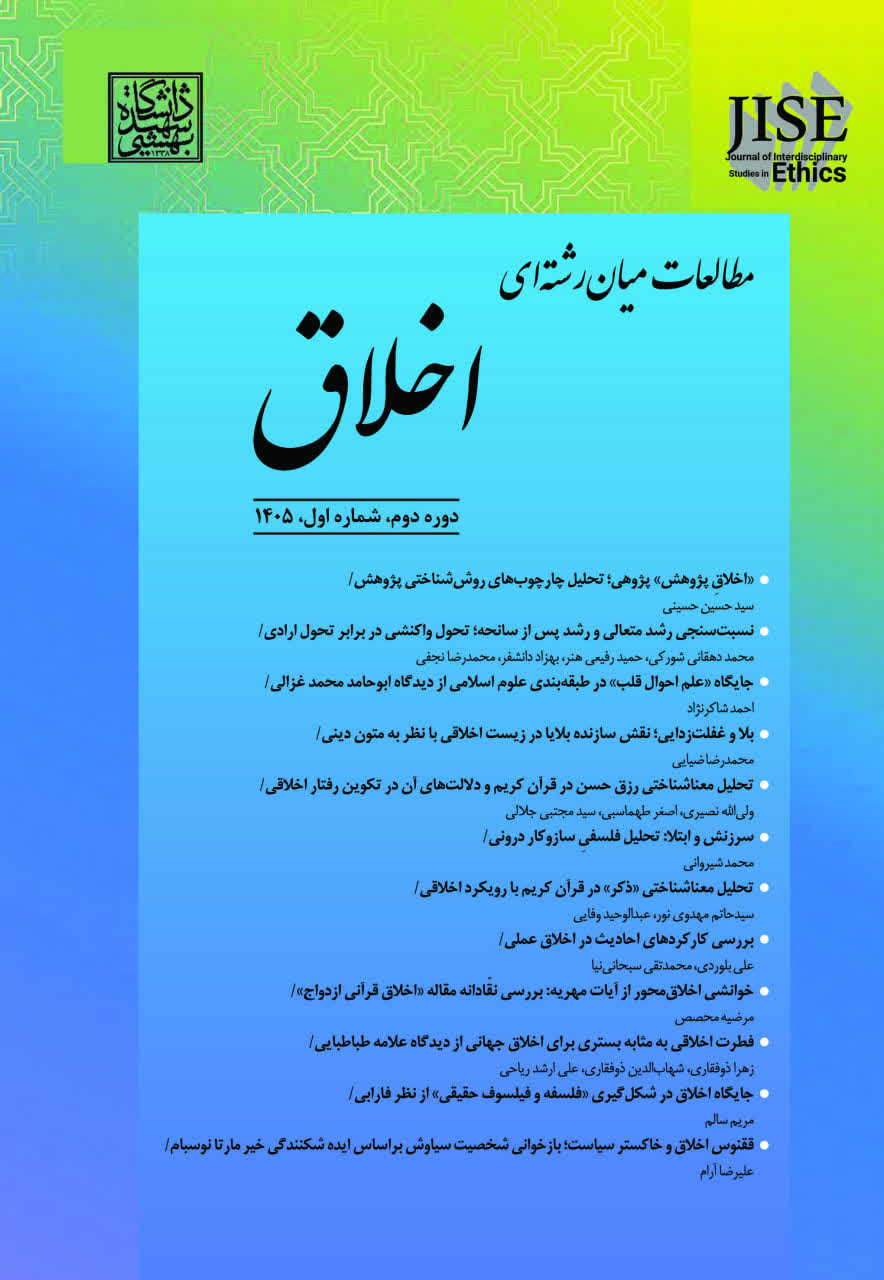
مطالعات میان رشته ای اخلاق

مطالعات میان رشته ای اخلاق

سرزنش و ابتلا: تحلیل فلسفیِ سازوکار درونی

نوع مقاله : مقاله پژوهشی

نویسنده
استادیار گروه معارف، دانشکده الهیات و ادیان، دانشگاه شهید بهشتی، تهران، ایران.
10.48308/jiethics.2026.242739.1042
چکیده
پدیده «ابتلای سرزنش‌کننده به خطا» در اخلاق اسلامی معمولاً با خوانش‌های ماورائی تفسیر شده است؛ در صورتی که این مفهوم را می‌توان در چارچوب فلسفه اخلاق، بدون حذف زمینه‌های روایی و روان‌شناختی به‌ صورت کاملاً طبیعی توضیح داد. مسئله این مقاله آن است که چرا و چگونه داوری تحقیرآمیز درباره دیگری، فاعل اخلاقی را در معرض لغزش اخلاقی قرار می‌دهد؛ پرسشی که از دیدگاه نظریه منش، انسجام داوری و ساختار خودآگاهی اهمیت بنیادی دارد. هدف از این مقاله، عرضه تبیینی فلسفی است که بتواند از میان سه دیدگاه فضیلت‌محور، کانتی و اگزیستانسیالیستی یک سازوکار مشترک استخراج کند و از شواهد روان‌شناختی و بازخوانی روایی برای تقویت تحلیل استفاده کند. روش پژوهش، تحلیلی‌ـ مفهومی است و داده‌ها از سنت اخلاق اسلامی، روان‌شناسی اخلاق و نظریه‌های مربوط به فاعلیت گردآوری و سپس در چارچوبِ مفهومیِ واحدی بازسازی شده‌اند. یافته‌ها نشان می‌دهند که سرزنش تحقیرآمیز در اخلاق فضیلت موجب اختلال در ثبات منش و خروج از حدّ اعتدال می‌شود، در دیدگاه کانتی، اصل جهان‌شمولی مختل شده، موجب فروپاشی انسجام عقل عملی می‌شود و از نظر اگزیستانسیالیستی، شکاف میانِ «خودِ اخلاقی» و «نقشِ اخلاقی» تشدید می‌‌گردد. شواهد روان‌شناختی درباره فرافکنی، خودفریبی و سوگیریِ توجه، و شواهد روایی اسلامی درباره غفلت از نفس نیز همین چرخه را تأیید می‌کنند. نتیجۀ مقاله این است که ابتلا را می‌توان مبتنی بر پیامد طبیعیِ فروکاست خودآگاهی اخلاقی دانست، نه رخدادی لزوماً ماورائی، بلکه فرایندی که در دل ساختار فاعلیت اخلاقی شکل می‌گیرد.
کلیدواژه‌ها

عنوان مقاله English

Blaming Someone and Being Infected with it: A Philosophical Analysis of Internal Mechanisms

نویسنده English

Mohammad Shirvani
Assistant Professor, Department of Education, Faculty of Theology, Shahid Beheshti University, Tehran, Iran.
چکیده English

Introduction: The phenomenon commonly described in Islamic ethics as the “affliction of the blamer with the very fault he condemns” has often been interpreted in metaphysical terms. However, it can be reinterpreted within moral philosophy as a natural outcome of the internal structure of moral agency. The central question of this study is why and how contemptuous moral judgment toward others exposes the moral agent to ethical failure. This issue is significant not only in religious ethics but also in modern moral theory, as it concerns the coherence of judgment, stability of character, and moral self-awareness. The aim of this article is to extract a unified explanatory mechanism from virtue ethics, Kantian ethics, and existentialist philosophy.
Findings: The analysis demonstrates that contemptuous blame disrupts three fundamental layers of moral agency. Within virtue ethics, such blame leads to a deviation from the mean and weakens moral character. Aristotle identifies excessive pride (hubris) as a condition that impairs practical wisdom and moral discernment (Aristotle, 1999). Once practical wisdom is weakened, the agent becomes vulnerable to hidden desires. Islamic ethical texts similarly describe this condition as self-neglect and moral blindness
(al-Kulaynī, 1987).
From a Kantian perspective, contemptuous blame violates the principle of universality. The agent applies a moral standard to others while exempting himself, thereby undermining the coherence of practical reason (Kant, 1998). This leads to the collapse of moral law as a guiding principle and turns it into a tool of judgment rather than self-regulation.
From an existentialist viewpoint, the phenomenon reflects a widening gap between the “authentic self” and the “moral role.” Contemptuous blame reinforces the moral role by positioning the agent as superior, yet this role is fundamentally inconsistent with the agent’s existential reality. This inconsistency produces an existential rupture that eventually leads to the collapse of the role, revealing the concealed truth (Sartre, 1956).
Psychological evidence further supports this analysis. Mechanisms such as projection, moral self-deception, and attentional bias explain how individuals externalize their own faults and lose moral self-awareness (Baumeister, 1998; Kahneman, 2011).

Discussion: The convergence of these perspectives suggests that “affliction” is not a metaphysical punishment but the natural outcome of a breakdown in moral agency. This breakdown unfolds through a cycle: contemptuous judgment, weakening of self-awareness, disruption of character and practical reason, and eventual enactment of the condemned behavior. Islamic narrations, such as “Whoever reproaches a believer for a sin will not die before committing it,” can thus be interpreted as descriptive of this internal process rather than supernatural retribution (al-Kulaynī, 1987).
This integrative account highlights the central role of ethical self-attention. Virtue ethics frames it as a condition for stable character, Kantian ethics as necessary for the coherence of practical reason, and existentialism as essential for authenticity. The loss of such self-attention initiates the cycle leading to moral failure.

کلیدواژه‌ها English

Ethics
Blame
Being Infected with the Subject of Blame
Virtue Ethics
قرآن کریم.
نهج‌البلاغه.
اصلانی، محمد (1402). تناقض ذاتیِ نظریه‏ معرفت کانت: بررسی نظریه‏ معرفت کانت براساس ملاک کانت در تشکیل معرفت. پژوهش‌های فلسفی، 17(43)، 299-319.
ری شهری، محمد (1380). میزان الحکمه. قم: دارالحدیث.
قائمی‌مقدم، محمدرضا (۱۳84). روش‌های آسیب‌زا در تربیت از منظر تربیت اسلامی، قم: پژوهشگاه حوزه و دانشگاه.
کلینی، محمد بن یعقوب (۱۴۰۷ق). الکافی. تهران: دارالکتب الإسلامیه.
مجلسی، محمدباقر (۱۴۰۳ق). بحارالأنوار. بیروت: مؤسسة الوفاء.
نراقی، احمد (۱۳۷۱). معراج السعاده. تهران: انتشارات اسلامی.
ترمذی، ابو عیسی (1366). سنن الترمذی، کتابخانه دیجیتال نور، جلد 2.
غزالی، ابوحامد (1370). احیاء علوم الدین، تهران، دار الکتب الاسلامیه.
Alicke, M. D. (2000). Culpable control and the psychology of blame. Psychological Bulletin, 126(4), 556–574. https://doi.org/10.1037/0033-2909.126.4.556
Aristotle. (1999). Nicomachean ethics (T. Irwin, Trans). Hackett Publishing.
Baumeister, R. F. (1998). “The self”. In: D. T. Gilbert, S. T. Fiske, & G. Lindzey (Eds.), The Handbook of Social Psychology. 4th ed., p.680–740. McGraw-Hill.
Beck, A. T. (1976). Cognitive therapy and the emotional disorders. New York: International Universities Press.
Blanken, I.,Van de Ven, N., & Zeelenberg, M. (2015). A Meta-Analytic Review of Moral Licensing. Personality and Social Psychology Bulletin, 41(4): 540–555.     
https://doi.org/10.1177/0146167215572134
Heidegger, M. (1962). Being and time (J. Macquarrie & E. Robinson, Trans.). Harper & Row.
Kahneman, D. (2011). Thinking, fast and slow. Farrar, Straus and Giroux.
Kant, I. (1998). Groundwork of the metaphysics of morals (M. Gregor, Trans.). Cambridge University Press.
MacIntyre, A. (1984). After virtue: A study in moral theory. University of Notre Dame Press.
Malle, B. F., Guglielmo, S. & Monroe, A. E. (2014). A theory of blame. Psychological Inquiry, 25(2), 147–186. https://doi.org/10.1080/1047840X.2014.877340
Polman, E. & Ruttan, R. L. (2012). “Effects of anger, guilt, and envy on moral hypocrisy”. Personality and Social Psychology Bulletin, 38(1), 129-139.                 
https://doi.org/10.1177/0146167211422365
Psychopathy: A Clinical and Forensic Overview. October 1997Psychiatric Clinics of North America, 29(3): 709-24. https://doi.org/10.1016/j.psc.2006.04.007
Sartre, J.P. (1956). Being and nothingness (H. Barnes, Trans). Philosophical Library.
Scanlon, T. M. (2008). Moral Dimensions: Permissibility, Meaning, Blame. Cambridge, MA: Belknap Press of Harvard University Press.
Taylor, C. (1989). Sources of the self: The making of the modern identity. Harvard University Press.
دوره 2، شماره 1 - شماره پیاپی 1
فروردین 1405
صفحه 119-114

  • تاریخ دریافت 11 آذر 1404
  • تاریخ بازنگری 06 اردیبهشت 1405
  • تاریخ پذیرش 07 اردیبهشت 1405
  • تاریخ اولین انتشار 07 اردیبهشت 1405
  • تاریخ انتشار 01 فروردین 1405